Mastering Retail Arbitrage: How to identify profitable product flips with a 40% margin in the current market
Advertisements
What if your next casual shopping trip could fund your entire month? Finding hidden treasures on clearance racks and turning them into high-yield online investments is the ultimate hack, and mastering Retail Arbitrage is exactly how modern side-hustlers are making it happen today.
The current market is bursting with mispriced inventory just waiting to be claimed. By targeting the right product flips, smart resellers are consistently locking in massive 40% profit margins simply by exploiting price differences between major local storefronts and digital marketplaces.
You don’t need a massive upfront investment or a giant warehouse to build this momentum. Here is your direct, no-nonsense roadmap to scouting high-demand inventory, calculating your returns, and scaling your e-commerce flipping game right now.
Understanding the Landscape of Retail Arbitrage
Retail arbitrage, at its core, involves purchasing products from traditional retail stores at a lower price and reselling them on online marketplaces for a higher price. The goal is to exploit price discrepancies and market inefficiencies to generate profit.
The dynamic nature of consumer demand, seasonal sales, and store liquidations constantly creates windows of opportunity for savvy arbitrageurs. Success hinges on a deep understanding of market trends and product value.
For those aiming for a 40% margin, it’s not just about finding any deal, but rather identifying specific products with significant profit potential. This requires a systematic approach to sourcing and a clear understanding of all associated costs.
The Fundamentals of Profitable Sourcing
Profitable sourcing begins with knowing where to look and what to look for. Discount stores, clearance sections, and seasonal sales are prime hunting grounds for retail arbitrage opportunities.
Understanding product categories that consistently yield higher margins is crucial. These often include electronics, toys, certain apparel brands, and home goods, especially during holiday seasons or specific sales events.
Developing a consistent sourcing routine and building relationships with store employees can also provide an edge. Early access to clearance events or knowledge of upcoming sales can be invaluable for Retail Arbitrage.
- Identify high-demand product categories.
- Target clearance sales and liquidation events.
- Utilize store loyalty programs for additional discounts.
The ability to quickly assess a product’s potential profitability while in-store is a critical skill. This involves more than just comparing prices; it encompasses understanding market demand and potential selling speed.
Key Tools and Technologies for Arbitrage Success
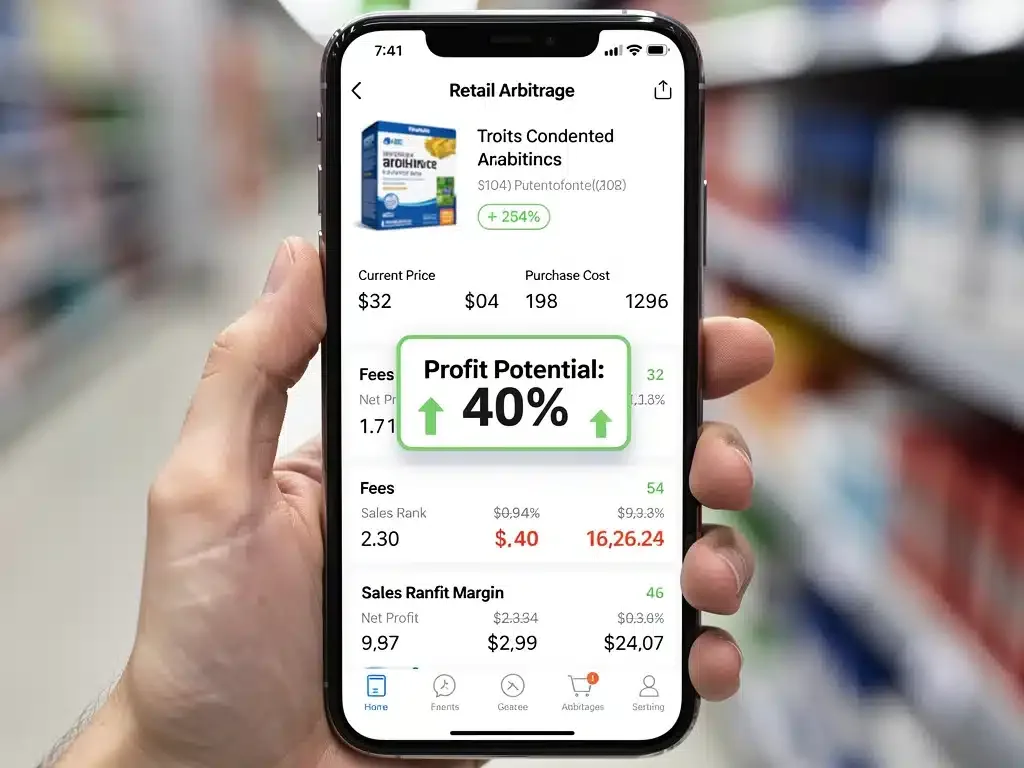
In today’s competitive retail arbitrage environment, technology plays an indispensable role in identifying profitable product flips. Various apps and platforms streamline the process, making it easier to achieve a 40% margin.
These tools provide real-time data on product rankings, sales history, and competitive pricing, allowing for informed purchasing decisions. Relying on guesswork is a surefire way to miss out on profitable opportunities.
Integrating these technologies into your sourcing strategy is not just an advantage; it’s a necessity for those serious about Retail Arbitrage.
Essential Scanning and Analysis Apps
Scanning apps are the arbitrageur’s best friend, enabling instant price comparisons and profitability calculations. Apps like Scoutify, SellerAmp, and Keepa provide crucial data points at your fingertips.
These apps often integrate with Amazon’s marketplace, showing historical sales data, buy box prices, and even potential restrictions on selling certain items. This prevents costly mistakes and guides purchases.
Learning to interpret the data provided by these tools, such as sales rank velocity and fluctuating prices, is key to making smart decisions. A low sales rank usually indicates a fast-selling item, crucial for quick flips.
- Scoutify: Real-time profitability calculations.
- SellerAmp: Comprehensive product analysis including hazmat alerts.
- Keepa: Historical price and sales rank data for Amazon.
Beyond individual product analysis, understanding broader market trends through these tools can inform your sourcing categories. Identifying emerging popular items before they become mainstream can lead to significant profit.
Calculating Profit Margins Accurately
Achieving a 40% margin is an ambitious but achievable goal in retail arbitrage, provided all costs are meticulously accounted for. Many new arbitrageurs underestimate the various fees involved, leading to diminished profits.
Accurate margin calculation involves more than just the purchase price and the projected selling price. It includes shipping costs, marketplace fees, storage fees, and even potential returns.
Retail Arbitrage hinges on this financial precision. Without it, even seemingly good deals can turn unprofitable.
All-Inclusive Cost Analysis
The purchase price is the most obvious cost, but it’s only the beginning. Shipping costs to get the product to your warehouse or directly to the customer (if FBM) must be factored in.
Marketplace fees, such as Amazon FBA fees, referral fees, and monthly subscription fees, can significantly eat into profits. These vary by product category and size, requiring careful consideration.
Don’t forget about potential storage fees, especially for slower-moving inventory, and the occasional cost of returns or damaged goods. A buffer should always be built into your profit calculations.
- Purchase Price: The initial cost of acquiring the product.
- Shipping Costs: To fulfillment centers or directly to customers.
- Marketplace Fees: Referral fees, FBA fees, storage fees.
By conducting a thorough cost analysis for each potential product, you can ensure that your target 40% margin is realistic and sustainable. This proactive approach minimizes financial surprises.
Strategic Sourcing for High-Margin Flips
Identifying products that consistently offer a 40% margin requires a strategic approach beyond simply scanning clearance aisles. It involves understanding consumer behavior, market cycles, and competitive landscapes.
Focusing on niche markets or underserved product categories can often lead to less competition and higher profit potential. Mass-market items, while selling quickly, might not always yield the desired margins.
Developing a network of reliable sourcing locations and staying informed about upcoming sales events are crucial for Retail Arbitrage.
Leveraging Seasonal and Holiday Sales
Seasonal sales, such as Black Friday, Cyber Monday, and post-holiday clearances, are prime opportunities for high-margin flips. Retailers aggressively discount inventory to make way for new stock.
Planning ahead for these events, researching historical pricing, and identifying potential hot items can give you a significant advantage. The key is to buy low when demand is temporarily suppressed and sell high when it rebounds.
Certain product categories, like holiday decorations, specific toys, or seasonal apparel, experience predictable price fluctuations. Timing your purchases and sales around these cycles is paramount.
- Black Friday/Cyber Monday: Deep discounts on electronics and general merchandise.
- Post-Holiday Clearance: Significant reductions on seasonal items.
- Back-to-School Sales: Opportunities in office supplies and electronics.
Beyond major holidays, local store-specific sales and manager markdowns can also provide excellent opportunities. Building relationships with store staff can sometimes offer advanced notice of these events.
Optimizing Listing and Fulfillment Strategies
Once profitable products are sourced, effective listing and fulfillment are critical to realizing that 40% margin. A poorly optimized listing or inefficient shipping can quickly erode profits.
High-quality product listings with accurate descriptions and appealing images attract more buyers and can justify a higher selling price. Professionalism in presentation matters.
Choosing the right fulfillment method, whether Fulfilled by Amazon (FBA) or Fulfilled by Merchant (FBM), also impacts profitability and customer satisfaction, both essential for Retail Arbitrage.
Crafting Compelling Product Listings
A well-written product title and description are vital for visibility and conversion. Use relevant keywords that potential buyers are likely to search for, ensuring your product stands out.
High-resolution images from multiple angles showcase the product effectively and build trust with buyers. Consider adding lifestyle images if appropriate to demonstrate product use.
Highlight key features and benefits, and accurately describe the product’s condition. Transparency reduces returns and improves overall customer experience, contributing to long-term success.
- Keyword-rich titles and descriptions.
- Clear, high-quality product images.
- Accurate condition descriptions.
Regularly review your listings for accuracy and competitiveness. Adjust pricing as needed to remain competitive while still achieving your desired 40% margin.
Managing Inventory and Scaling Your Business
Effective inventory management is fundamental to sustaining profitability in retail arbitrage. Overstocking can lead to increased storage fees and slow-moving capital, while understocking means missed sales opportunities.
Tracking inventory levels, sales velocity, and reorder points helps maintain a healthy cash flow and prevents stockouts. This is especially important when dealing with high-volume, fast-flipping items.
Scaling your retail arbitrage business requires a structured approach to inventory, ensuring that your efforts in Retail Arbitrage are not undermined by logistical challenges.
Efficient Inventory Tracking and Storage
Utilize spreadsheets or inventory management software to keep a detailed record of all purchases, sales, and current stock levels. This data is invaluable for identifying trends and making informed decisions.
Organize your storage space efficiently to minimize handling time and prevent damage to products. Proper labeling and categorization can significantly improve workflow, especially as your inventory grows.
Regularly review your inventory for slow-moving items and consider strategies like price adjustments or bundling to clear them out. Holding onto unprofitable inventory can tie up capital that could be used for new flips.
- Implement robust inventory tracking systems.
- Optimize storage for quick access and protection.
- Develop strategies for managing slow-moving stock.
As your business scales, consider outsourcing fulfillment or utilizing Amazon FBA more extensively to free up your time and resources for sourcing and analysis, which are the core activities for high margins.

Mitigating Risks and Overcoming Challenges
While the potential for a 40% margin in retail arbitrage is attractive, the business also comes with inherent risks and challenges. Understanding and mitigating these is crucial for long-term success.
Market fluctuations, increased competition, and policy changes on selling platforms can all impact profitability. A proactive approach to risk management is essential for stability.
Addressing these challenges head-on ensures that your efforts in Retail Arbitrage remain sustainable and profitable.
Addressing Common Arbitrage Pitfalls
One common pitfall is purchasing products without thoroughly checking for selling restrictions or intellectual property claims. This can lead to account suspensions or unsellable inventory.
Another challenge is accurately predicting demand. Overestimating demand for a product can result in holding onto inventory for too long, incurring storage fees and tying up capital.
Staying updated on marketplace policies, such as Amazon’s terms of service, is paramount. Non-compliance can lead to severe penalties, including account termination, effectively ending your arbitrage business.
- Verify selling restrictions before purchasing.
- Accurately forecast product demand.
- Stay informed on marketplace policy changes.
Diversifying your product categories and sales channels can also help mitigate risks. Relying on a single product or platform can leave your business vulnerable to unforeseen changes.
Building a Sustainable Arbitrage Business
Beyond individual flips, the ultimate goal for many is to build a sustainable retail arbitrage business that consistently generates high margins. This involves strategic planning, continuous learning, and adaptability.
Establishing clear business goals, developing a brand identity, and focusing on customer satisfaction contribute to long-term growth. Arbitrage can evolve from a side hustle into a primary income stream.
The journey of Retail Arbitrage is ongoing, requiring constant refinement of skills and strategies to stay ahead.
Long-Term Growth and Brand Development
Consider transitioning from pure retail arbitrage to wholesale or private label once you’ve gained significant market insight. This can offer greater control over product sourcing and branding.
Building a strong reputation as a reliable seller cultivates customer loyalty and encourages repeat business. Excellent customer service is a powerful differentiator in a crowded marketplace.
Continuously educate yourself on new arbitrage techniques, market trends, and e-commerce best practices. The retail landscape is always evolving, and staying informed is key to sustained success.
- Explore wholesale and private label opportunities.
- Prioritize exceptional customer service.
- Engage in continuous learning and adaptation.
By focusing on these long-term strategies, retail arbitrage can transform from a series of individual transactions into a robust and scalable business, delivering consistent 40% margins and beyond.
| Key Aspect | Description for 40% Margin |
|---|---|
| Profitable Sourcing | Focus on clearance, seasonal sales, and unique items with high demand and low competition. |
| Margin Calculation | Accurately factor in all costs: purchase price, shipping, marketplace fees, and potential returns. |
| Technology Use | Leverage scanning apps and data analysis tools for real-time pricing and sales rank insights. |
| Risk Mitigation | Verify selling restrictions, diversify products, and stay updated on marketplace policies to avoid pitfalls. |
Frequently Asked Questions About Retail Arbitrage
What is retail arbitrage, and how does it work?▼Retail arbitrage involves buying products from brick-and-mortar stores at a low price and reselling them online for a profit. It works by exploiting price differences due to sales, clearance, or regional demand variations, often on platforms like Amazon or eBay.
Is achieving a 40% profit margin realistic in retail arbitrage?▼Yes, a 40% profit margin is realistic with strategic sourcing and meticulous cost calculation. It requires focusing on high-demand, low-competition items during sales events, and carefully accounting for all fees, including shipping and marketplace commissions.
What tools are essential for identifying profitable product flips?▼Essential tools include smartphone scanning apps like Scoutify or SellerAmp for real-time profitability analysis, and data analysis platforms like Keepa for historical sales rank and pricing trends. These tools are crucial for informed purchasing decisions.
How can I minimize risks in my retail arbitrage business?▼Minimize risks by always checking for selling restrictions before buying, diversifying your product categories, and staying updated on marketplace policies. Accurate demand forecasting and a buffer for unexpected costs also contribute to risk mitigation.
What are the best places to source products for retail arbitrage?▼The best places to source products include clearance sections of major retailers, discount stores, liquidation sales, and seasonal holiday sales (e.g., Black Friday, post-Christmas). Local store markdowns can also yield significant opportunities for profitable flips.
Perspectives
The continuous pursuit of Retail Arbitrage remains a dynamic field for entrepreneurs. As market conditions evolve and consumer buying habits shift, staying agile and informed will be paramount.
Future developments in e-commerce technology and supply chain logistics will undoubtedly present new avenues and challenges for those dedicated to maximizing their arbitrage potential.
Monitoring industry reports and adapting strategies will be key to sustained success and achieving those lucrative 40% margins.